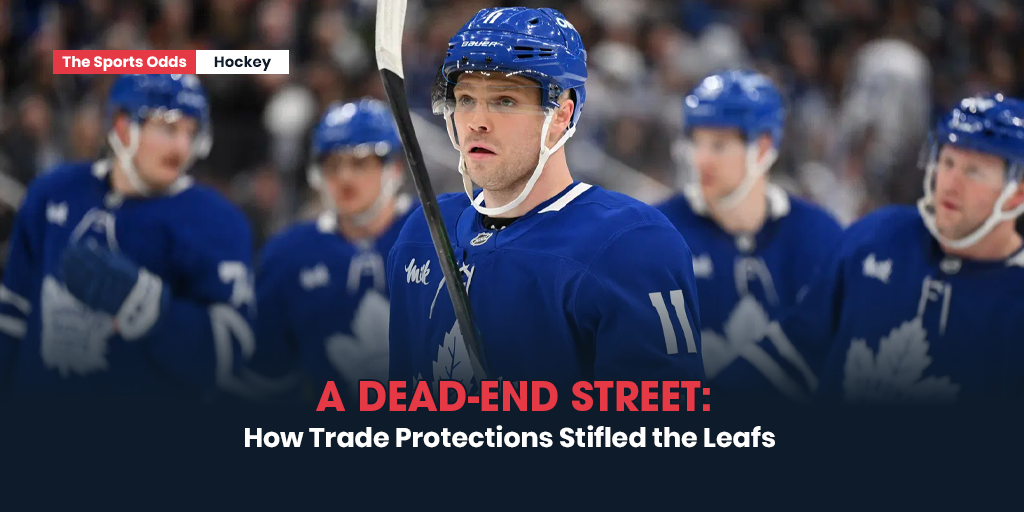
As the Toronto Maple Leafs transition into a new era of management, the mandate for the incoming General Manager is becoming increasingly clear: the era of handing out restrictive contract clauses must come to an end. For years, the organization has found itself structurally disadvantaged by a surplus of No-Move Clauses (NMC) and No-Trade Clauses (NTC). This trend has not only limited the team’s ability to pivot during disappointing seasons but has also created a roster dynamic where the players hold significantly more leverage than the front office.
The Staggering Reality of Roster Deadlocks
Currently, the Maple Leafs’ roster is a complicated web of legal protections that would challenge even the most seasoned executive. A deep dive into the team’s current salary structure reveals that a staggering 12 players possess some form of trade protection. While it is standard practice in the modern league to grant these concessions to elite “core” players, the Maple Leafs have extended these privileges far beyond their top-tier talent.
It is understandable that perennial All-Stars and franchise pillars like Auston Matthews and William Nylander have secured their futures in Toronto. Similarly, the veteran presence of John Tavares justifies such a clause given his history with the club. However, the frustration within the fan base and among analysts stems from the “middle-class” of the roster receiving similar protections. According to The Sports Odds, a prominent sports news site, the lack of mobility for secondary pieces is what truly hampers a team’s ability to improve via the trade market.
A Comparative Analysis of Trade Protection
The issue becomes even more glaring when comparing Toronto to its peers. While other successful franchises also utilize NTCs and NMCs, there is a distinct difference in the results yielded by those teams.
- Tampa Bay Lightning: 13 players with NTCs or NMCs (including 3 on expiring deals).
- Vegas Golden Knights: 14 players with NTCs or NMCs (including 3 on expiring deals).
- Florida Panthers: 10 players with NTCs or NMCs.
- Toronto Maple Leafs: 12 players with NTCs or NMCs.
The critical distinction is that the Panthers, Lightning, and Golden Knights have all secured Stanley Cup titles with the very players they have “locked in.” In contrast, the Maple Leafs have struggled to advance deep into the postseason, yet they continue to provide their roster with the same level of security enjoyed by champions. This lack of accountability has led many to believe that the team is stuck on a “dead-end street” regarding roster flexibility.
The Defense and Bottom-Six Conundrum
Perhaps the most baffling aspect of Toronto’s contract management is the distribution of clauses among the defensive corps and depth forwards. Five of the team’s top six defensemen currently hold some degree of control over their destination. This effectively prevents the next GM from “cleaning house” or performing a necessary overhaul of the blueline.
In the bottom-six, the trend continues. Max Domi possesses a modified no-trade clause, and even winger Dakota Joshua has secured protection. Most surprisingly, Calle Jarnkrok—who has at times been a healthy scratch—holds a clause that limits the team’s ability to move his salary. These are the types of “handcuffs” that prevent a team from being agile as we head toward the NHL 2026 season.
The Montreal Model of Flexibility
To see a different path, one need only look toward the Montreal Canadiens. GM Kent Hughes has maintained an enviable level of flexibility by keeping the majority of his young stars on contracts devoid of trade protection.
The Canadiens currently have only five players with any form of NMC or NTC. Notably, their young core—including Nick Suzuki, Cole Caufield, Juraj Slafkovsky, Noah Dobson, and Lane Hutson—all lack trade protection. This strategy ensures that if the team needs to pivot or address a specific hole in the lineup, the “exit lanes” remain open. Even their top prospect, Ivan Demidov, is on an entry-level contract with no such hurdles.
A New Direction for the Next GM
The incoming leadership in Toronto must prioritize reclaiming leverage. While the existing clauses cannot be retroactively removed, the next GM must draw a line in the sand for all future negotiations. The current lack of control is a self-inflicted wound that has stifled the team’s growth.
There are small signs of hope, such as Matthew Knies currently playing without trade protection. Maintaining this standard for upcoming signings will be vital. As reported in Hockey News, the goal is not to punish players but to ensure the organization can adapt to the ever-changing landscape of professional sports. If the Maple Leafs hope to return to the playoffs and finally make a deep run, they must stop treating no-move clauses like “Halloween candy” and start treating roster spots as something that must be earned and maintained through performance.