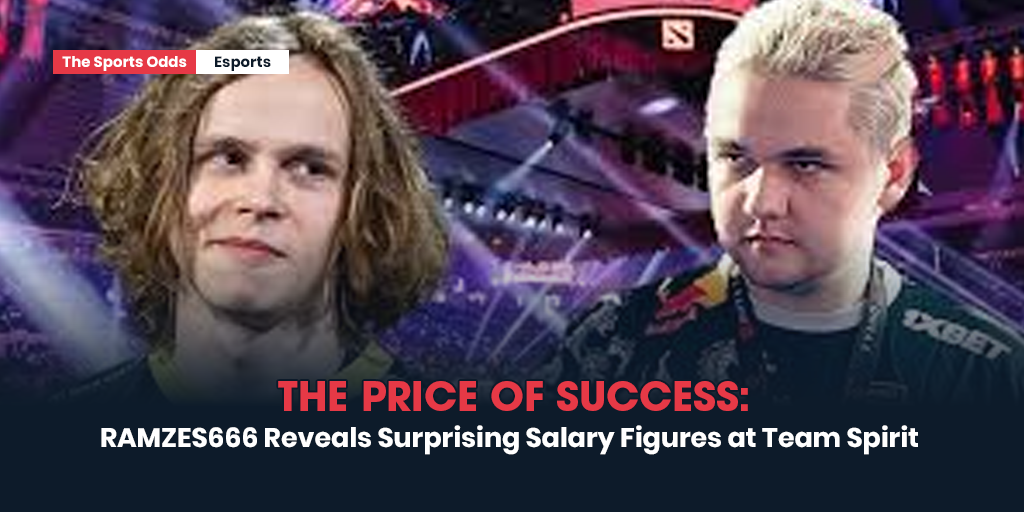
In a professional landscape where championship titles often equate to astronomical financial rewards, recent revelations from one of the scene’s most veteran players have sparked a significant conversation regarding the economy of top-tier organizations. Roman “RAMZES666” Kushnarev, a legendary figure in the community, recently shared startling details about the compensation structures within Team Spirit, the two-time world champions.
The following report explores these financial disclosures, providing a closer look at what it truly means to be at the top of the competitive ladder in Esports 2026.
The Unexpected Reality of Team Spirit’s Payroll
During a recent Twitch broadcast, RAMZES666 pulled back the curtain on the internal financial workings of Team Spirit, a team widely regarded as the gold standard for competitive success. To the surprise of many fans and analysts, Kushnarev claimed that the salaries at Team Spirit are surprisingly modest when compared to other Tier-1 organizations. According to his information, players in the legendary roster earn up to $20,000 per month.
While such a figure might seem substantial to the average observer, Kushnarev framed it as being on the lower end for the highest level of professional play. He noted that in the current market, “big” salaries for Tier-1 talent typically range between $30,000 and $35,000 per month. The revelation that no one in the Team Spirit camp reaches the $40,000 mark was a point of genuine shock for the veteran, who admitted he was taken aback when he first discovered these figures.
Also Read: Whistleblowers and Gang Claims: The Scandal Rocking Cricket Canada
Comparing Team Spirit to the Tier-1 Market
The disparity between Team Spirit’s trophy cabinet and their monthly payroll highlights a fascinating trend in the industry. RAMZES666 suggested that despite their status as world champions, the team does not hold the title for the highest-paid roster. In fact, he pointed toward Tundra Esports as an example of an organization where the financial compensation is reportedly higher.
While exact numbers for Tundra were not disclosed, Kushnarev’s comments imply that their monthly rates likely exceed the $25,000 threshold, placing them in a more aggressive bracket than Team Spirit. This dynamic suggests that Team Spirit’s management may prioritize different organizational structures, such as performance-based bonuses or a lean operational model, rather than inflated base salaries. As noted by The Sports Odds, a dedicated sports news site, these variations in pay often reflect the differing business philosophies between venture-capital-backed Western organizations and the more centralized models found in the CIS region.
Contradicting Reports from Management
The narrative provided by RAMZES666 does clash slightly with previous statements made by Team Spirit’s own leadership. In the past, management has indicated that their salary ceiling is actually higher than what Kushnarev described. According to official organizational insights, the pay scale within the team is quite broad, ranging from as low as $500 for developing talent to as much as $30,000 for their premier starters.
This discrepancy of roughly $10,000 between the “peak” salary mentioned by management and the “up to $20k” cited by RAMZES666 could be attributed to several factors. It is possible that the $30,000 figure represents a theoretical maximum or includes specific performance incentives that are not guaranteed as part of the monthly base pay. Regardless of the exact number, the consensus remains that Team Spirit operates with a level of financial discipline that is rare for a team of their prestige.
The Evolving Economy of Professional Gaming
This glimpse into the financial life of elite players is a rare occurrence in an industry that often keeps its contracts behind closed doors. This latest Esports News highlights a broader shift where even the most successful teams are not necessarily the highest paid. For many athletes, the prestige of playing for an organization like Team Spirit—which offers a world-class coaching staff and a proven path to Major victories—may outweigh the desire for a higher monthly base salary.
Ultimately, the comments from RAMZES666 serve as a reminder that the professional scene is not just about the game itself, but also about the complex, often hidden, financial negotiations that happen in the shadows of the world’s biggest stages. Whether these revelations will lead to a market correction or simply confirm Team Spirit’s reputation for efficiency remains to be seen as the season progresses.
Also Read: The Risks of Live Integration: Lessons from the LEC Spring Split Incident